

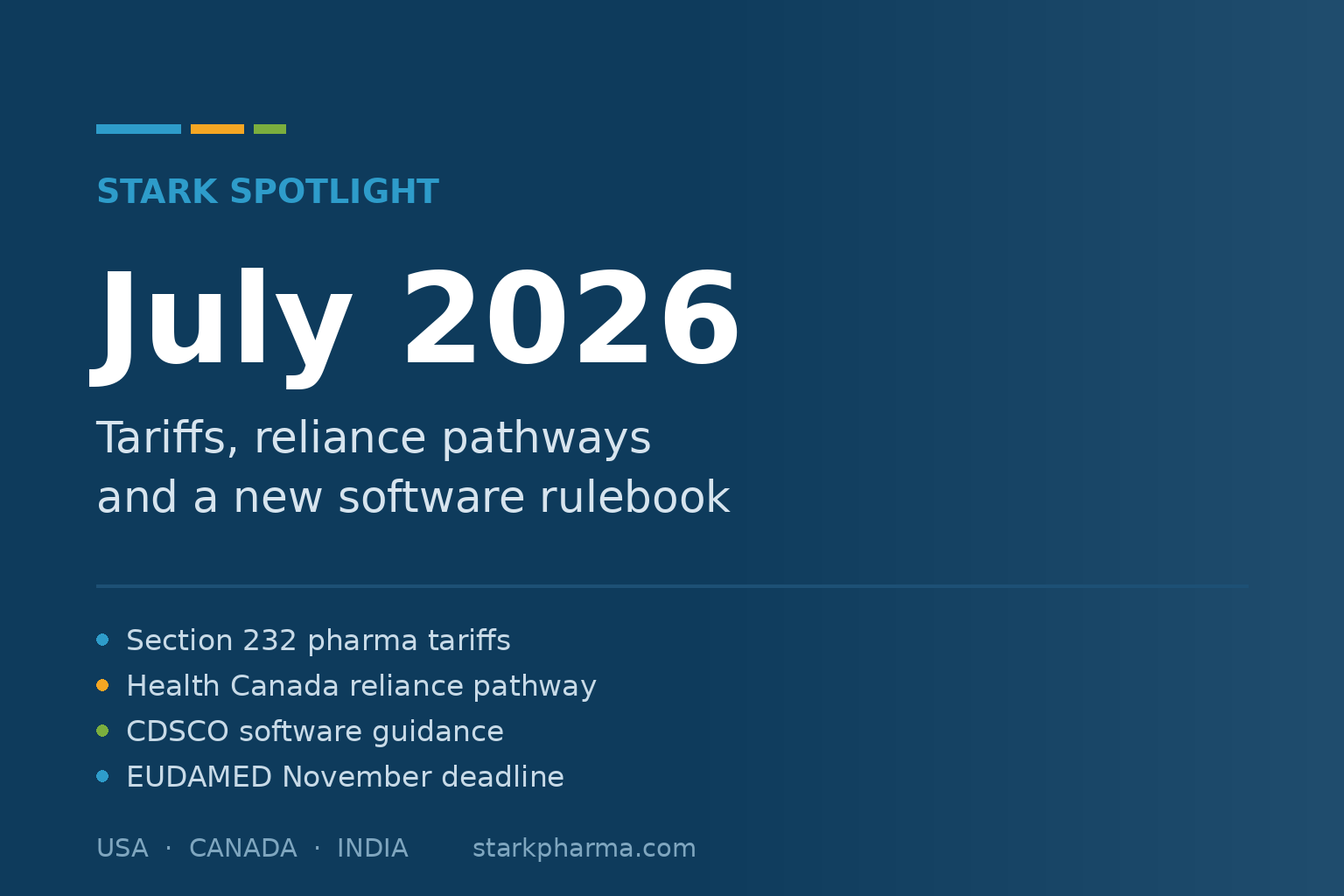
Welcome to the July edition of Stark Spotlight, our monthly read on what is moving across pharma, biotech, medical devices and life sciences IT in the US, Canada, India and the EU.
July was a month where policy, more than science, set the agenda. Three regulators moved on the same underlying question — where a product is made, who reviewed it, and how that is proven — and a new US tariff structure turned manufacturing footprint into a regulatory planning problem. Below is what happened and what it changes for the teams who have to execute against it.
Section 232 tariffs on patented pharmaceutical imports began taking effect on 31 July 2026. The headline rate is 100% on patented products listed in the FDA’s Orange Book or Purple Book, along with related active pharmaceutical ingredients. Reduced rates apply to several trading partners — 15% for Japan, EU member states, South Korea, Switzerland and Liechtenstein — and separate treatment applies to companies with an approved onshoring plan or a most-favoured-nation pricing agreement, each running on its own expiry date. A group of 17 named companies has implementation deferred to 29 September 2026.
The exemptions matter as much as the rates. Generics, biosimilars, US-origin products, orphan-designated drugs, cell and gene therapies, antibody drug conjugates, plasma-derived therapies and developmental candidates all sit outside the structure for now.
What it changes: tariff exposure is now a function of where a product is registered and manufactured, which makes it a regulatory and supply chain question rather than a purely commercial one. Organisations that treat onshoring commitments, establishment registration and submission timing as one plan will move faster than those running them as three separate workstreams.
The approval run continued through July. Atacicept-vymj received accelerated approval on 7 July for primary IgA nephropathy, supported by Breakthrough Therapy designation. A subcutaneous formulation of isatuximab-irfc was cleared on 9 July for multiple myeloma across three combination regimens. On 10 July, pembrolizumab in combination with enfortumab vedotin was approved for muscle-invasive bladder cancer, reviewed under the Project Orbis international framework.
The more structurally interesting item was also dated 10 July: a proposed rule to modernise drug manufacturing establishment registration, aimed at hub-and-spoke distributed manufacturing and at foreign establishments producing APIs and components for non-US downstream manufacturers. Two final guidances followed on 14 July, one updating bioequivalence methodology for generic topical corticosteroids and one setting out formal meeting procedures for OTC monograph sponsors.
What it changes: if distributed manufacturing networks can register differently, then oversight, data integrity and inspection readiness have to be demonstrated across sites rather than at one. That lands squarely on validation and quality functions.
Health Canada published draft guidance on foreign regulatory reliance on 15 July, alongside a Ministerial Reliance Order. The framework lets Health Canada rely on decisions and review documents from specified foreign regulators, through three routes: general deeming where a foreign regulator has already authorised a product, a 120-day filing pathway allowing Canadian submissions within 120 days of a foreign filing, and joint review with foreign regulators. The consultation period runs to 12 September 2026.
What it changes: for innovator companies, the 120-day pathway is the one to plan around, because it can pull Canadian launch timing much closer to global timelines. Generic and biosimilar sponsors are designated for later phases and see little immediate effect.
CDSCO published its Guidance Document on Medical Device Software under the Medical Devices Rules, 2017 on 21 July. It applies to standalone software and embedded applications with a medical purpose, and classifies them across four risk classes, A through D, based on intended use and the criticality of the healthcare decision being supported.
The AI provisions are the substantive part. Manufacturers are expected to document development methodology, identify AI-specific risks including bias, model drift and hallucination, and validate performance across relevant populations including Indian clinical settings. Alongside that sit lifecycle quality management obligations, cybersecurity requirements, technical documentation covering training datasets and algorithm change protocols, and ongoing post-market performance monitoring.
What it changes: software teams building for the Indian market now need the same documentation discipline that device teams have carried for years. For AI-enabled products, validation evidence has to be population-specific, which is a design and data question, not a paperwork one.
EUDAMED’s four functional modules — Actor, UDI/Device, Notified Body and Certificates, and Market Surveillance — became mandatory on 28 May 2026. The deadline that now matters is 28 November 2026, by which devices already on the market before May and still being sold must be registered. Notified bodies have until 28 May 2027 to register certificates issued before mandatory use began. The post-market surveillance and clinical investigation modules are still in development.
What it changes: November is a data exercise, not a regulatory one. Most of the work is assembling accurate UDI and device records at scale, and organisations consistently underestimate how long that takes.
Vertex Pharmaceuticals agreed on 6 July to acquire Crinetics Pharmaceuticals for approximately $10 billion, its largest transaction to date, moving Vertex into endocrinology. The pattern through 2026 has been buyers paying up for late-stage and commercial-stage assets rather than broad early-stage acquisition.
Every item above converts into demand for a specific kind of experience. Through July and into the second half, the profiles our clients are asking for most consistently are:
The common thread is that compliance work is moving upstream into design, data and manufacturing decisions. The people who can operate across that boundary are the ones in short supply.
Stark Pharma provides consulting and contract talent to pharmaceutical, biotech, medical device and healthcare IT organisations across the US, Canada and India, covering clinical operations, regulatory affairs, quality, validation, pharmacovigilance and life sciences IT.
If you are planning against any of the deadlines above and need capability quickly, contact us at sales@starkpharma.com. Professionals exploring their next role can reach us at jobs@starkpharma.com.
Follow Stark Pharma Solutions Inc on LinkedIn for future editions of Stark Spotlight.

 +1 (848) 393-8666
 hello@starkpharma.com

 Back to Blogs